Bata Journey
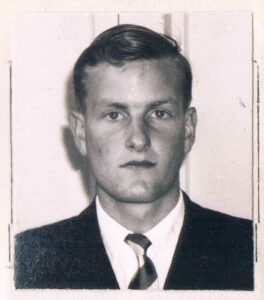
Gordon Butland 1958-1966
The Beginning
In early 1958, I was a) worried about ‘a’ levels and b) what was I going to do at after the sixth form would end in August. Then I saw an advertisement in the News Chronicle newspaper, now extinct, offering a scholarship combined with practical experience at the Bata Shoe Company in East Tilbury.
I was from Plymouth and had only been outside of Devon or Cornwall once in my life and that was to play football for Plymouth Schoolboys at Brighton, where we lost 4-2, followed by a trip to London before catching the train home. So first I had to look up where East Tilbury was. I said nothing to Mum and Dad and wrote a letter applying for a scholarship. On receiving a favourable reply and being called for an interview I then told my parents who were very supportive. I do not remember much about the interview, except for Dennis Bacon and being very impressed by the size of the hotel, factory, the estate and all the surrounding facilities.
The Course
I was put into the Rubber stream, based on my Pure and Applied Maths, Physics and Chemistry ‘A’ levels. There was 6 months in the company and six months at the National College of Rubber Technology, a part of London University and situated at Holloway Road, nicely situated for White Hart Lane, but more about that later
Life inside the Factory gates
I cannot remember the exact sequence of all the departments I went through but I do recall key incidents that became a part of my life.
Making tennis shoes, more commonly known as plimsolls then
First experience of working on a conveyor. Quickly learnt about teamwork and industrial relations at its basic level. If someone had to stop the line a light would go on above their head, and every stop meant less production and less wages for the whole department, so you learnt very quickly not to be the one responsible. Our schoolboy soft hands suffered in the early days but there was a tremendous motivation! Instead of our students’ money of Two pounds a week we received the workers wage of TEN pounds a week that enabled a much different 18-year-old lifestyle. At the end of the period in each department we had to type up a manual on an antique typewriter and make samples. This was reviewed by the department manager and the results went into your record.
Reclaim Department
The most physically tiring of the whole course. First you had to cut up huge, and often heavy, tyres from tractors or large trucks on a large guillotine, making sure you got your hands out of the way. The pieces were then treated, and the resulting rubber sheets were turned into the soles for shoes
Presses for making basketball type footwear
First introduction into working individually being paid by piece work. Workers did not trust management not to reduce the piece rate, so they only did the standard number of pairs per shift, 200. One of my college colleagues was very keen on money and started to do 220. When he came back from his break someone had turned off his press and he had to wait for it to heat up again. He only did that once! Also, us students were always given the big size 11 that was more difficult. It was also my first experience of shift work. There were three shifts 6 am to 2 pm, 2 pm to 10 pm and 10 pm to 6 am. This probably helped me not having many jet lag issues when travelling in later life.
Making plastic shoes
There was a separate building for the plastic shoes. At that time, they were cheap for people on low incomes. Today there is quite a fashion element. There were two types of plastic shoes, one was produced on an automatic conveyor that produced a rain protective bootee to slip over your normal shoes. The other type was producing a sandal type shoe produced on a rotary injection machine with 10 stations and the operator had to remove the sandal from the mould, as the table rotated and stopped. If you could not remove the shoe quick enough you had to stop the machine, and this lowered your production and your wages.
In the beginning we used PVC granules and then the R&D developed a liquid plastisol, that saved a lot of electricity costs, and the development of this innovation was directly responsible for the second phase of my Bata journey and the first phase of my global life.
One incident that I remember well is that I was working a 12 hour night shift and the only person working in the building. The security guard would make his round every hour. At 2 am one morning I cut my hand quite badly but as I was producing red shoes, I did not realise it was blood. When I did realise I phoned the guardhouse and a guard took me to the house of Dr Ward on the estate to stitch me up.
Another innovation is that an injection machine was installed in a large truck that then went to Cyprus and was plugged in at every village and made shoes there. Fortunately, a college colleague, cannot remember his name, only that he married the prettiest girl on the estate. He had to learn not only how to operate the machine but also how to drive the huge truck. I am sure there would have been a few less lamp posts standing if I was driving.
Costing
My passage through the costing department helped me to find my true vocation. I was always, and still am, a numbers and data person. Later during my stay in Sierra Leone I did a correspondence course and took parts 1 to 3 of the Institute of Cost and Works Accountants examinations there and then when I arrived back in Brazil in 1966 post Bata, I completed parts 4 and 5, thus starting my 60 year finance career.
All costing in my period was done in Pence and the final number was then converted into Pounds, Shillings and Pence. The only “automation” available was a Burroughs manual adding and subtraction machine. Multiplications were either slide rules, log tables or “in your head”.
Bata operated a very interesting financial system. The purchasing department sourced, added its overhead and a margin and sold to the receiving room. The receiving room would add its overhead and margin and sell to the production department. This was then done all through the value chain. The financial week was Tuesday to Monday and on Fridays, Mr.Tusa would go to every department and review the weeks income statement and performance with the foreman of that department. Part of staff remuneration every week was based on that performance.
Once a week I volunteered for stock taking in the small Bata supermarket.
Selling shoes
Twice a year we would go to a Bata shop, usually in London, and sold shoes. We earned commission on our sales of the day, and the commission was higher on accessories such as shoe polish and socks, so we learnt all about “Cross selling” very easily.
Academic life
For the first two years, we resided in the college at East Tilbury and commuted every day to Holloway Road. A walk, or sprint sometimes, to catch the train to Fenchurch Street, and then the tube from Aldgate to Holloway Road with one change. Then in the afternoon back again during rush hour to East Tilbury. I am sure there were many rainy days. In the third year I lived at Charlton with an uncle and that made travelling shorter but not much, and still a long and often cold walk to the station.
My academic record was not good, and I was somewhat ashamed to see my marks in Chemistry, that I hated, on my Bata College report that the Heritage has provided me with. I did not complete the four-year course, opting to go into full time production life in September 1961. I would have been much better in the Administration stream, but then I would not be where I am, very happily, today.
The best part of my academic life was the proximity to Spurs at White Hart Lane, and this is when they completed the double. I remember watching the European Cup semifinal against Benfica, who had won the first leg 3-1 and scored early on to make it 4-1. Spurs pulled two goals back but could not find the equalizer. I was hoarse that night. The team included Danny Blanchflower and Dave Mackay and Benfica had young Eusebio. In the following year Spurs bought Jimmy Greaves and that made them even more exciting to watch.
The worst part of the three years was the suicide of a fellow student in our year. He went home at the weekend and did not return. Automatic counselling did not exist in those days and each of us had to deal with it in our own. Way.
Other activities at East Tilbury
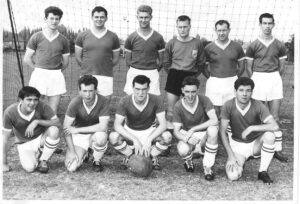
Weekends were all about sport with football in the winter and cricket in the summer. In one of the years the college went unbeaten throughout the whole season and later I played in goal for the Bata team on a regular basis.
Our Bata cricket team had a Pakistan player, a great character besides being a very good cricketer. We won most games and the other ten of us only had to turn up as he batted and bowled for all of us.
Saturday evenings were cinema at Stanford-le-Hope or Grays with Fish and Chips after. On Sunday evening I seem to remember there was a film at the Bata Cinema nearby the hotel.
I had two serious girl friends in the 5 years at East Tilbury. One was Pauline who suddenly informed me that she was going to marry an older Bata manager. Her father, a factory foreman, who did not like me, put remark in the Bata Record that “All was fair in love and war”. I met up with Pauline for lunch about 40 years later, on one of my UK visits.
The other was Vera, a daughter of one on of the many Czech managers who was a wonderful person who let us borrow his car on Sunday afternoons. I met Vera again in 1985 with her husband in Sydney, Australia.
Holidays and Christmas were spent in Plymouth and in the early years that meant hitch hiking. I used to start at Hounslow, and it was very easy to get lifts in those days. Later after I got my driving license, I would hire a car and always remember returning on Boxing Day 1962 when the snow was just starting to fall. The next day when we woke up there was a lot of snow and difficult to walk to the factory. That was my last winter in England, and I have lived in hot climates ever since.
The day that changed my life
On a Friday afternoon in April 1963 at 4pm I was called to the HR department. Obviously, getting fired crossed my mind, but instead, the question was “Do you want to go to Brazil in two weeks’ time?”. I nearly blurted out, that’s a stupid question, but instead I asked what I was going to do there. The assignment would be for three months to help implement the Hiplast system of using plastisol instead of PVC granules. That conversation completely changed my life as it resulted in me living the rest of my life away from England, although my English food habits have not changed in 60 years.
Brazil
So, on May 7, 1963, I was off to London Airport, it only became Heathrow in 1966. The airline was BOAC, and the plane was a VC 10. It took 20 hours to get to Sao Paulo stopping in Lisbon, Dakar, Recife, Rio and Sao Paulo and the airport in Sao Paulo was in Campinas about 55 Miles from the city. A young guy my age named Roberto met me, he did not speak English, and I did not speak Portuguese and we chatted all the way to Sao Paulo. Today the flight is direct and takes half the time.
The company in Brazil was called Ancora, as the Bata name was being used by Thomas Sr. brother. There was a lengthy dispute that went up to the international court at the Hague. Management was all French (I think Mr. Mauss was the CEO) and I was housed in a very nice guest house close to the most important roa, Rua Augusta, in the city.
The plant was some distance away on the highway to Santos and in front of a mental institution that everybody knew the location, so easy to give directions. On the first day the Brazilians, including Sybille, the secretary to Mauss, who I then married on August 14th, took me to lunch at a nearby canteen and (tried) to introduce me to the famous Brazilian dish, Feijoada (Pork and black beans) and it put me off to such an extent that I never could get to like it. Instead, I ate “Bife a cavalo” that means steak with an egg on top. The egg was the jockey on the horse. This was the only thing that I could speak in Portuguese for some time so that was my regular menu.
Those years saw the golden years for Brazilian football with Pele and his team Santos dominating Brazilian and world football. However, the first game that I went to was with Corinthians and I have been an ardent Corinthians supporter ever since. So, my Bata journey gave me the opportunity of watching up close two of the best ever teams in the world at their peak.
My Brazilian story would not be complete without a word about Sybille’s first taste of England. I had to go on to Mexico and Canada, so Sybille had to go by herself to England. She was met at the airport by my Uncle Tom who lived in Woolwich and two days later he put her on the train to Plymouth where my mum and dad met her. She did not feel well the next day and mum took her to the family GP and a few hours later she was in hospital having her appendix removed. When she recovered, she was walking around Plymouth Hoe, where I had suffered a serios diving accident a decade before when I was 13, when a Man asked her what she was looking at. It turned out he was one of the people who “fished” me out of the water and saved my life. Have a scar on forehead to go with the Bata acquired hand scars.
Mexico
In early September I moved on to Mexico, where the company was called Calzados Sandak. Mexico has many memories for me, as it is a country with a rich history. I visited the pyramids where the Aztecs carried out human sacrifices, went to Guadalajara and a weekend in Acapulco when it was a global tourist attraction. These years were before the drug problems made the country less attractive.
I also remember that I was having lunch when the news came through that Kennedy had been assassinated in Dallas. Playing football for the local company, then as centre forward, in the high altitude for the company team was also part of my history.
Canada
In early December, I went on to Batawa in Canada, where I had the honour to meet Thomas Bata Jr. and his wife Sonja. I saw the engineering part of Bata, where not only did they produce equipment for the shoe factories, but parts for jet planes and power stations. Then it was home to England to meet up and back to East Tilbury to get ready to go to Iraq, that was going to be for a four-year period.
Iraq
On January 4th, 1964, off to London airport again, and we were on our way to Baghdad. On arrival the pilot said it was 28 degrees, and I assumed that was Celsius, but it was Fahrenheit, so getting off the plane (all stairs in those days) was rather cold. A couple of months later it was 50 degrees Celsius, and you could fry an egg on the pavement. There was no air conditioning in those days, but there was an air cooler that comprised of a fan and a wet filter that kept us reasonably cool. Water was in a tank on top of the roof, and you did not need a heater to have a hot bath.
In 1964 it was the pre-Baath party days and Baghdad and Iraq were very nice to live in. I travelled extensively within Iraq by train buying materials for Bata and never had any problems and never felt uncomfortable. Sybille worked at a lawyers’ office, and we lived on a street with camels. There was a mosque nearby and when someone died the prayers were often well into the night. We had a houseboy who was a very nice person, and he told us stories that he had to give so many sheep to buy his wife’s parents to marry her.
Work had no problems, and once you could show the Iraqis that you knew your job they respected you and would help in any way they could. Everything was going well until in mid-July we arrived at the factory, and it was full of armed soldiers. Bata, along with many other companies, had been nationalized. So, we had to leave, but we were treated very well. They asked us to pass all documentation, instructions and suggestions to the local staff, we received all the financial remuneration due to us, and our baggage was sent to our next destination.
Bata then decided that I should go to Beirut, that was the Monte Carlo of the Middle East at that time. I was earmarked to go to Sierra Leone where there was a partnership with a Lebanese family Yazbek.
There was one final hiccup on leaving. We got on a plane took our shoes off ready to go to Beirut when the pilot announced, “Welcome to the flight to Damascus”. Panic, but we collected our things and boarded the correct plane.
Lebanon
We spent about a month in Beirut and met the Yazbeck family. We also visited the plant in Jordan and went to Jerusalem when it still belonged to Jordan. I got to swim, or rather floated, in the Dead Sea.
Sierra Leone
In early September I started, what was to be the final and most challenging part of my Bata journey. The first challenge was to travel from Beirut to Freetown. First, I went to Khartoum in the Sudan for a week and then flew across to Lagos, Nigeria, before ending up in Freetown, where the airport was on an island and there was a ferry to the mainland. This was before the country slid into chaos and probably most of you have seen the film Blood Diamond with Leonardo de Caprio.
There were 3 tribes in Sierra Leone, Temne, Mende and Limba and it was necessary to allocate each tribe to one of the eight hour shifts and not mix them on the same shift. There was a common language, Krio, that sounded like pigeon Enlish, so was easy to learn. There were less problems because of skin colour than between the tribes and I never suffered any problems because I was white. During this period Rhodesia declared itself independent from Britain and this caused somewhat of a backlash. I even spent an hour in prison for contempt of court because I missed a court hearing as a witness.
Training people was difficult and finding electrical and mechanical technicians was not easy This meant I had to do a lot of the repairs myself and I ended up with a few more stitches on my hand to partner those from my East Tilbury days.
Sybille was pregnant and we decided that she would go to Brazil to give birth as we were worried about having adequate health facilities in Freetown. This was the correct decision as it was a difficult birth, and it is doubtful that our daughter Trixy would have survived. Sybille arrived back in Freetown with our 6-week-old daughter and promptly got malaria. She had a temperature of well over 100, but the doctor said this was normal. As soon as she was fit enough to travel, she returned to Brazil.
At least I learnt how to play golf in Freetown, as there was little else to do at weekends. Nine months of the year it was like playing on concrete and 3 months like a swamp. Greens were made of sand and caddies had long toes so you ball was always sitting up. Sometimes monkeys would steal the ball.
In the final weeks of my stay, it was World Cup time in England. I listened on the radio to all the games up to the semifinal and I was back in England to see the final on television.
Life after Bata
In Brazil from late 1966 until 2004, in various financial positions until joining Rabobank in 1989. At that time, I was in Chile and Brazil with sugar, salmon, paper, fruit and finally chicken. Since then, I have been in the chicken industry for 35 years, so far, going to nearly every country that produces on a reasonable scale. I started coming to Asia in 1993 and from 1996 to 2004 when I retired from Rabobank I lived between Sao Paulo and Thailand. I then became a full-time consultant in the industry and still keep nicely occupied, learning new things every day with Artificial Intelligence applications saving hours of work. Also, I have been able to research a lot of interesting Bata history in the countries that I worked in.
Conclusion
The eight years that I spent with Bata shaped my life personally and professionally. It gave me work ethic that I still practice wherever I am involved. In the early days, with our college white coats, on the production line sometimes thinking what is useful about doing this, we did not realize that discipline was being absorbed by us automatically. I look back on those years with a sense of satisfaction and achievement and my experience gathered has been worth more than the certificate that I did not obtain academically.